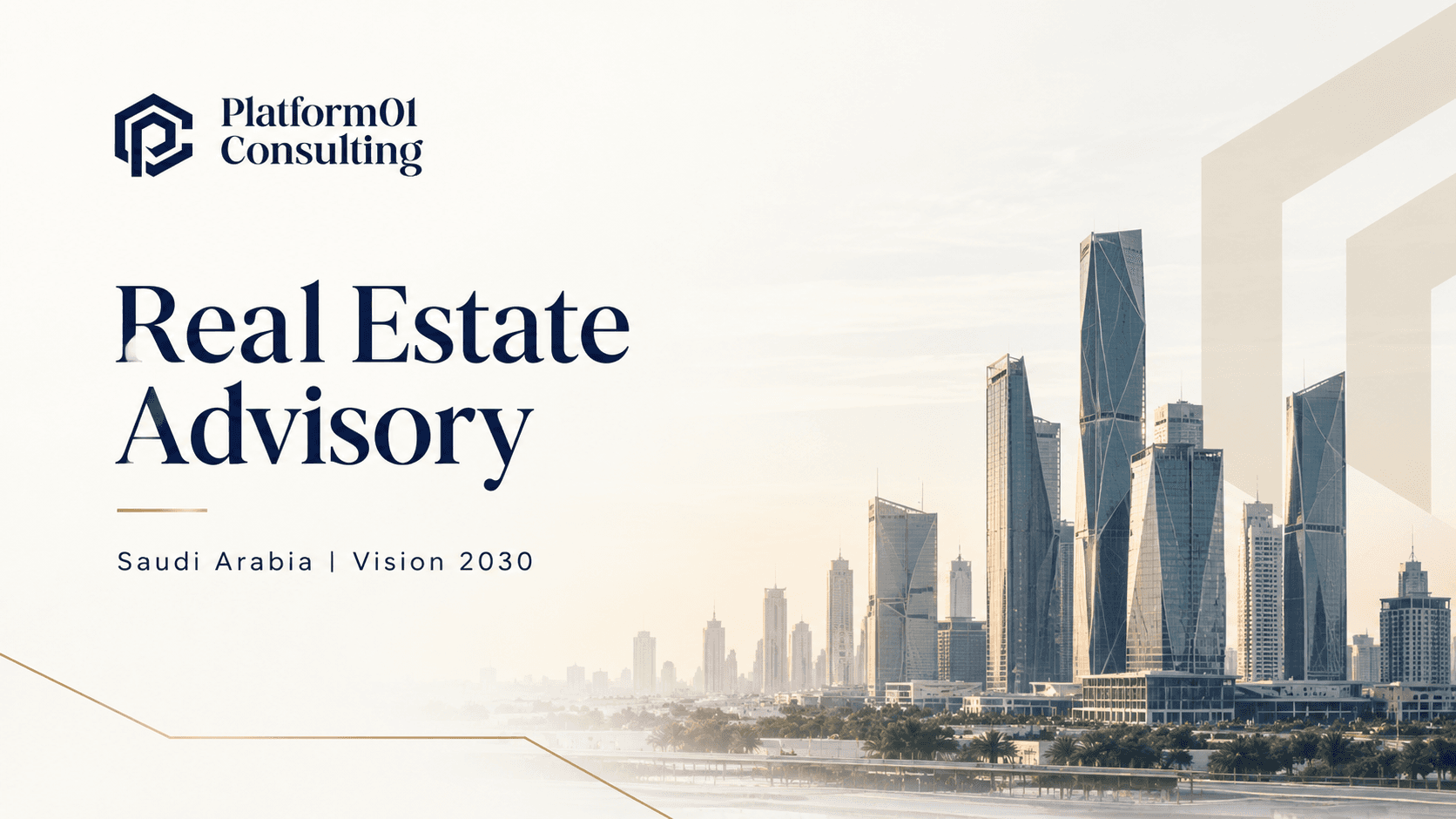
Real Estate Advisory in Saudi Arabia: Unlocking Investment Opportunities Under Vision 2030
Saudi Arabia’s real estate sector is undergoing significant transformation as the Kingdom advances its economic diversification agenda under Vision 2030. From large scale urban developments and tourism destinations to commercial property, residential communities, and infrastructure projects, the sector is creating new opportunities for investors, developers, and businesses.
However, identifying the right opportunities requires more than market optimism. Investors must assess demand, understand regulatory requirements, evaluate financial returns, and account for project risks before committing capital. This is where real estate advisory can play an important role in supporting informed investment decisions and sustainable development.
How Is Saudi Vision 2030 Transforming the Real Estate Sector?
Saudi Vision 2030 aims to diversify the Kingdom’s economy, attract investment, develop tourism, improve quality of life, and create more vibrant urban communities. Real estate is an important part of this transformation because new residential, commercial, hospitality, and mixed-use developments support broader economic growth.
Major development programmes and projects across Riyadh, Jeddah, and emerging tourism destinations are contributing to changing property requirements. Growing business activity, population needs, tourism demand, and infrastructure investment are also influencing where and how real estate opportunities emerge.
For investors and developers, these changes create potential opportunities across several segments, including:
Residential real estate: Housing developments that respond to population growth, changing household needs, and evolving urban communities.
Commercial property: Offices, retail spaces, and mixed-use developments that support business expansion and economic activity.
Hospitality and tourism: Hotels, resorts, and tourism-related properties that benefit from the Kingdom’s efforts to strengthen its visitor economy.
Industrial and logistics real estate: Warehousing, distribution facilities, and industrial properties that support trade, manufacturing, and supply chain development.
Mixed-use developments: Integrated communities combining residential, commercial, leisure, and other facilities.
Nevertheless, not every development opportunity will deliver the same returns. Market conditions, location, financing costs, construction expenses, and the pace of demand can significantly affect project viability.
Why Real Estate Advisory Matters in Saudi Arabia
As the Saudi property market evolves, investors and developers need reliable analysis to distinguish commercially attractive opportunities from projects carrying excessive risk.
Professional real estate advisory services can help businesses evaluate potential investments, understand market dynamics, and make decisions based on financial and commercial evidence. Rather than relying solely on projected demand or headline development announcements, investors can assess whether a particular opportunity aligns with their objectives, available capital, and risk appetite.
Key areas of support may include:
Market and sector analysis to understand demand, competition, and emerging opportunities.
Investment appraisal to assess expected returns, capital requirements, and potential risks.
Financial modelling to test project economics under different assumptions.
Feasibility studies to evaluate commercial viability before significant capital is committed.
Strategic planning to prioritise investments and support long-term growth.
Commercial due diligence to evaluate the assumptions and risks behind an investment opportunity.
These services are particularly relevant for businesses considering new developments, portfolio expansion, acquisitions, or entry into unfamiliar segments of the Saudi real estate market.
Real Estate Investment Advisory Services: Evaluating Opportunities and Returns
Real estate investment decisions involve substantial capital commitments and often require a long-term perspective. A project that appears attractive based on projected sales or rental income may face challenges when construction costs, financing requirements, operating expenses, and market risks are taken into account.
Real estate investment advisory services help investors evaluate these factors before proceeding with a transaction or development.
A structured investment assessment typically considers several questions:
1. Is there sufficient market demand?
Investors need to understand the needs of prospective buyers, tenants, businesses, and visitors. Demand should be assessed in the context of the specific location, property type, competitive supply, and expected delivery timeline.
2. Is the project financially viable?
Financial analysis helps estimate development costs, potential revenue, operating expenses, funding requirements, and expected returns. Scenario analysis can also show how results may change if prices, occupancy rates, construction costs, or completion dates differ from initial assumptions.
3. What are the principal investment risks?
Potential risks include regulatory changes, construction delays, cost overruns, financing constraints, oversupply, and weaker-than-expected demand. Identifying these risks early enables investors to make better-informed decisions and consider appropriate mitigation measures.
4. Does the opportunity align with the investment strategy?
A project should fit the investor’s objectives, risk tolerance, investment horizon, and available resources. A commercially viable development may still be unsuitable if it does not align with the investor’s wider portfolio or strategic priorities.
By addressing these questions, investment advisory can help investors compare opportunities more consistently and allocate capital more effectively.
The Role of Real Estate Development Consultancy
Successful property development requires coordination between market research, project planning, financial assessment, and commercial decision-making. Even projects in high-growth locations can encounter difficulties when development assumptions are unrealistic or market demand is not properly evaluated.
Real estate development consultancy helps developers assess the commercial and strategic aspects of a proposed project before and during the development process.
This may involve evaluating the target market, assessing competing developments, reviewing project assumptions, analysing financial feasibility, and identifying factors that could affect delivery or profitability.
For projects in Saudi Arabia, development planning should also account for local market conditions, relevant regulatory requirements, infrastructure availability, and the specific objectives of the development.
A structured approach can help developers answer important questions:
Is the proposed development suited to the location and its target market?
Are projected sales, rental income, or occupancy assumptions realistic?
Do the expected returns justify the capital and risks involved?
What changes could improve the project’s commercial viability?
How might alternative scenarios affect the investment decision?
Addressing these questions early can help reduce uncertainty, improve resource allocation, and establish a stronger basis for investment and development decisions.
How Investors Can Approach Saudi Arabia’s Real Estate Opportunities
Although Vision 2030 is creating new avenues for investment, a disciplined approach remains essential. Investors should avoid making decisions based solely on the scale of a development announcement or the perceived attractiveness of a location.
A practical assessment process should begin with a clear investment objective, followed by market research, financial analysis, risk evaluation, and an independent review of key assumptions.
Investors should also consider how economic conditions, financing costs, competing supply, infrastructure development, and project timelines could influence performance. Where appropriate, feasibility studies and scenario-based financial models can help establish whether an opportunity remains attractive under different market conditions.
For international investors and businesses entering Saudi Arabia, understanding the local commercial environment is equally important. Working with experienced advisers can provide additional analytical support when evaluating market entry, development partnerships, acquisitions, or portfolio expansion.
How Platform01 Consulting Supports Real Estate Investment Decisions
Platform01 Consulting supports businesses and investors with commercial analysis and strategic advisory services to help them evaluate opportunities and make informed decisions.
Through its real estate consulting offering, the firm can support clients in assessing market opportunities, evaluating investment assumptions, examining financial viability, and developing a clearer understanding of the commercial considerations surrounding real estate projects.
Its wider advisory capabilities, including feasibility studies, financial modelling, investment appraisal, and commercial due diligence, can help investors and developers assess opportunities from multiple perspectives before committing resources.
Explore Platform01 Consulting’s Real Estate Consulting services to learn more about its approach to real estate strategy and investment analysis.
Conclusion
Saudi Arabia’s real estate sector is evolving alongside the Kingdom’s broader economic transformation under Vision 2030. Investment in housing, commercial property, tourism, logistics, and mixed-use developments presents opportunities, but successful outcomes depend on careful planning and realistic commercial assessment.
Real estate advisory can help investors identify opportunities, assess risks, and evaluate potential returns. Meanwhile, real estate investment advisory services and real estate development consultancy can support more disciplined decisions throughout the investment and development process.
For businesses and investors looking to participate in Saudi Arabia’s changing property market, combining a clear investment strategy with robust financial and commercial analysis can provide a stronger foundation for sustainable, long-term value creation.
Shafi Akhund, FMVA® is a Senior Consultant – Strategy and Advisory at Platform01 Consulting, supporting clients across strategy, financial analysis, and advisory engagements. Connect with Shafi on LinkedIn.
Disclaimer: This article is published for informational and search optimization purposes. Nothing in this article constitutes investment advice, financial advice, or a recommendation to buy or sell any security or investment. Platform01 Consulting Group provides management consultancy and investment consultancy services. IPEV portfolio valuations are prepared as analytical and management consultancy deliverables. Clients should satisfy themselves regarding any regulatory or reporting requirements applicable to their specific fund structure, jurisdiction, or investor obligations. Always verify current regulatory requirements with the appropriate authority.