About the Author
Shafi Akhund is a Senior Consultant Strategy & Advisory at Platform01 Consulting, with experience across strategy, M&A, financial analysis and transaction advisory.
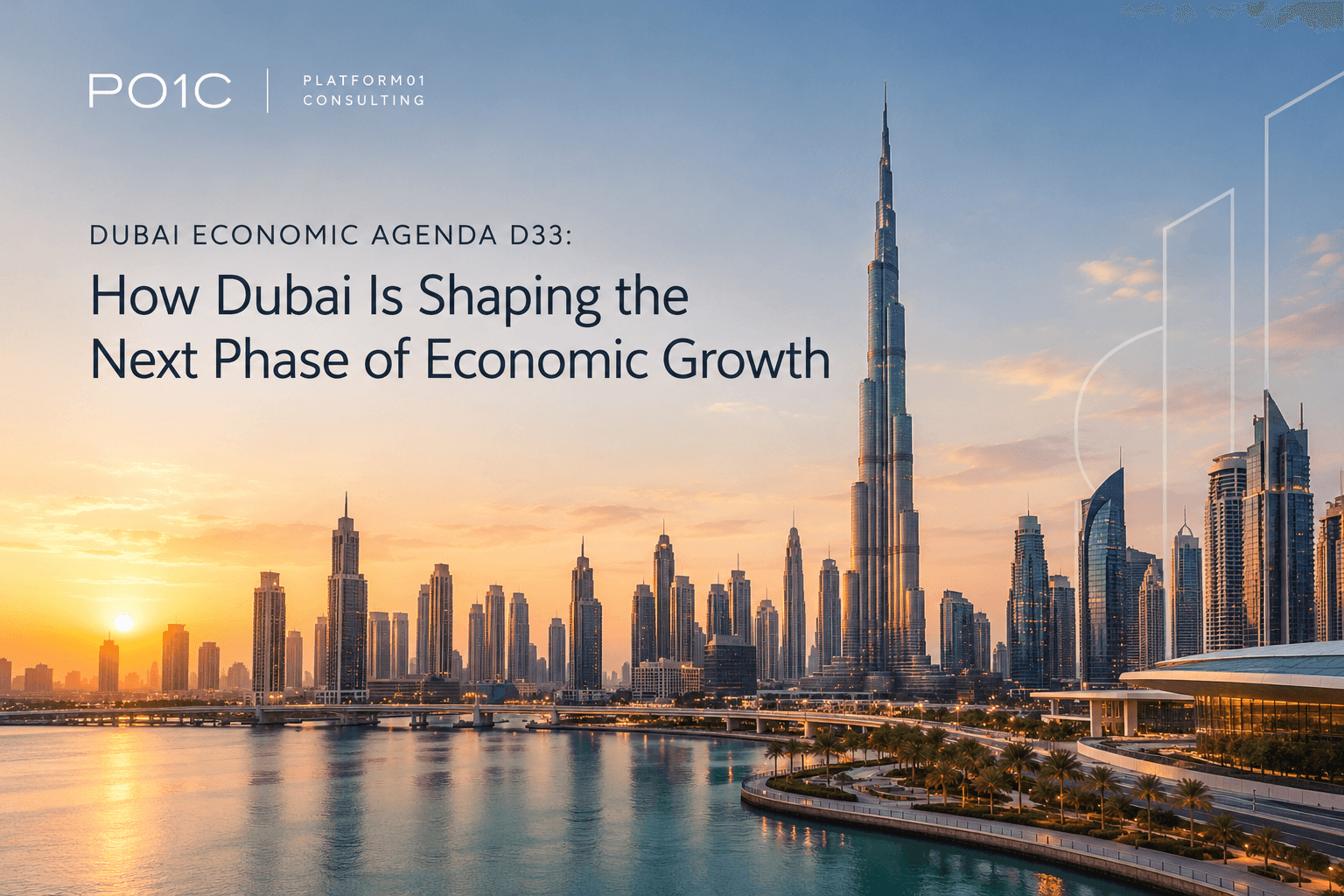
Dubai Economic Agenda D33: How Dubai Is Shaping the Next Phase of Economic Growth
Dubai has established itself as one of the world's leading business and investment hubs, connecting companies, investors and markets across the Middle East, Asia, Europe and Africa. With the launch of the Dubai Economic Agenda D33, the emirate has set out an ambitious roadmap for the next decade, focused on expanding economic growth, strengthening international competitiveness and creating new opportunities for businesses and investors.
The strategy aims to double the size of Dubai's economy by 2033 while positioning the city among the world's top three urban economies. Achieving these objectives requires more than government led investment. It also creates opportunities for private sector expansion, foreign investment, strategic partnerships and mergers and acquisitions.
For companies considering expansion in the UAE, understanding D33 is therefore important not only from a policy perspective but also from a commercial and investment standpoint.
What Is Dubai Economic Agenda D33?
Dubai Economic Agenda D33 was launched in 2023 as a long-term economic strategy designed to strengthen Dubai's position as a global business and investment centre.
The agenda includes a wide range of initiatives covering trade, technology, manufacturing, tourism, logistics, financial services, entrepreneurship and the digital economy. It also seeks to strengthen Dubai's position as a destination for international companies and investors.
A major feature of D33 is its emphasis on increasing the contribution of the private sector to Dubai's future economic growth.
This creates an environment in which businesses can pursue organic expansion while also considering strategic acquisitions, joint ventures and cross-border investments.
How D33 Could Accelerate M&A Activity in the UAE
Economic diversification often creates opportunities for consolidation. As new industries develop and established companies expand, businesses may look toward acquisitions to gain market share, access new capabilities or enter new geographic markets.
This makes M&A advisory in UAE increasingly relevant for companies evaluating strategic growth opportunities.
An acquisition can provide a faster route into a new market than building operations from the ground up. For example, an international company entering the UAE could acquire an established local business with existing customers, regulatory knowledge, employees and distribution infrastructure.
Similarly, UAE-based companies seeking international expansion may use acquisitions to establish a presence in other markets.
However, successful transactions require more than identifying a potential target. Buyers need to understand the commercial attractiveness of the opportunity, assess the target's financial position and identify operational, regulatory and integration risks.
This is where structured M&A transaction advisory services can support the decision making process.
Strategic Sectors Under Dubai's Economic Transformation
D33 covers multiple sectors that could generate opportunities for investors and businesses.
Technology and the Digital Economy
Dubai continues to invest heavily in digital infrastructure, artificial intelligence, fintech and emerging technologies. As technology adoption accelerates, established businesses may look to acquisitions as a way of gaining access to specialised technology, intellectual property and skilled teams.
Technology companies can also become attractive acquisition targets when larger businesses seek to accelerate their digital transformation.
Logistics and Trade
Dubai's geographical position and infrastructure have made it an important global logistics and trading hub.
The continued development of logistics, supply chains and international trade supports opportunities for companies operating across transportation, warehousing, procurement and distribution.
As these markets consolidate, businesses may explore strategic combinations to improve scale, expand geographic coverage and strengthen their supply chains.
Tourism and Hospitality
Tourism remains an important component of Dubai's economic strategy. Growth in visitor numbers, hospitality infrastructure, entertainment and related services creates opportunities for both local and international investors.
Companies entering these sectors may consider acquisitions of established operators as part of their market-entry strategies.
Financial Services
Dubai's financial ecosystem provides another area for growth, particularly across fintech, wealth management, payments and other specialised financial services.
As financial businesses expand across the UAE and wider GCC, strategic acquisitions can provide access to customers, technology and new capabilities.
Why M&A Advisory Matters for UAE Businesses
M&A transactions can create significant value but they also involve considerable financial and commercial risks.
Businesses considering an acquisition need to answer several important questions:
Is the target strategically aligned with the buyer?
Is the valuation justified by the company's financial performance and future potential?
Are there hidden commercial or operational risks?
Can the acquisition generate sufficient returns?
What synergies could realistically be achieved?
How difficult will post-transaction integration be?
Are there regulatory or cross-border considerations?
Professional M&A advisory services can help companies evaluate these questions before committing significant capital.
A structured advisory process typically involves target identification, commercial analysis, financial assessment, valuation, due diligence and transaction planning.
For larger transactions, the process may also involve assessing financing requirements, negotiating transaction terms and developing a post-merger integration strategy.
The Growing Importance of Cross-Border M&A
One of Dubai's greatest advantages is its position as a gateway between international markets.
Companies based in Europe, Asia and other parts of the Middle East frequently view the UAE as an entry point into the GCC. At the same time, UAE-based companies increasingly seek opportunities beyond their domestic market.
Cross-border transactions, however, introduce additional complexity.
Differences in regulations, accounting practices, taxation, corporate structures, market conditions and business cultures can affect the success of a transaction.
This is why businesses often require M&A advisors with best cross-border experience when evaluating international transactions. Understanding both sides of a transaction can help investors identify risks that may not be immediately visible from financial statements alone.
Cross-border M&A can also provide UAE businesses with access to new customers, technologies, talent and intellectual property, supporting the broader objective of building globally competitive companies.
The Role of Procurement and Operational Synergies
Procurement can be an important but sometimes overlooked component of M&A value creation.
When two companies combine, there may be opportunities to consolidate suppliers, negotiate better purchasing terms, eliminate duplicate contracts and improve procurement processes.
This can be particularly relevant in industries with significant operating or supply-chain costs.
Companies evaluating potential procurement M&A firms should therefore consider not only the transaction itself but also the operational improvements that could be achieved after completion.
Procurement synergies should be quantified during the transaction evaluation rather than treated as an assumption after the deal closes. A realistic assessment can help buyers determine whether projected cost savings are achievable and how quickly they can be realised.
What Investors Should Consider Before an M&A Transaction
The UAE's growth environment can create attractive opportunities, but businesses should conduct detailed analysis before pursuing a transaction.
Commercial Due Diligence
Commercial due diligence examines the target's market position, customers, competitors, growth prospects and business model.
It helps investors determine whether the company's projected growth is supported by realistic market conditions.
Financial Analysis and Valuation
A target's historical financial performance should be assessed alongside its forecasts and future cash-generation potential.
Valuation methodologies may include discounted cash flow analysis, comparable company analysis and precedent transaction analysis, depending on the nature of the business.
Strategic Fit
An acquisition should have a clear strategic rationale.
The transaction could provide market access, technology, customers, geographic expansion, operational efficiencies or complementary capabilities. Without a clear rationale, even a financially attractive transaction can create integration challenges.
Regulatory and Transaction Considerations
UAE transactions can involve sector-specific regulations, competition considerations and other legal or regulatory requirements.
Cross-border transactions may introduce additional requirements in the buyer's or target's home jurisdiction.
Post-Merger Integration
The transaction does not end when the acquisition closes.
Integration of people, technology, processes, reporting structures and corporate cultures can determine whether the expected value from the transaction is ultimately achieved.
D33 and the Future of UAE Investment
Dubai Economic Agenda D33 represents a long-term effort to strengthen Dubai's economic position and increase its global competitiveness.
For businesses, this environment can create opportunities beyond traditional organic growth. Strategic acquisitions, partnerships and cross-border investments can allow companies to scale faster, enter new markets and acquire capabilities that would otherwise take years to develop internally.
For investors, the key is identifying opportunities where economic growth, market fundamentals and company-specific value creation come together.
As Dubai continues to diversify its economy, the importance of disciplined M&A advisory and strategic transaction planning is likely to increase.
At Platform01 Consulting (P01C), we support businesses and investors navigating growth opportunities across the UAE and wider GCC. Our services span M&A advisory, transaction analysis, valuation, feasibility studies and strategic planning, helping clients evaluate opportunities and make informed investment decisions in a rapidly evolving market.
Conclusion
Dubai Economic Agenda D33 is more than a government economic roadmap. It represents a broader transformation of Dubai's business environment, creating opportunities across technology, logistics, tourism, financial services, manufacturing and other growth sectors.
For UAE-based companies and international investors, this transformation can create compelling opportunities for expansion through acquisitions, partnerships and cross-border investment.
However, identifying an opportunity is only the first step. Successful transactions require rigorous commercial analysis, financial modelling, valuation, due diligence and a clear integration strategy.
Businesses considering acquisitions in Dubai or across the UAE can benefit from experienced M&A transaction advisory services that connect strategic objectives with detailed transaction analysis. As D33 continues to shape Dubai's economy through 2033, businesses that approach growth opportunities with disciplined strategy and informed decision-making will be better positioned to participate in the next phase of the UAE's economic development.